

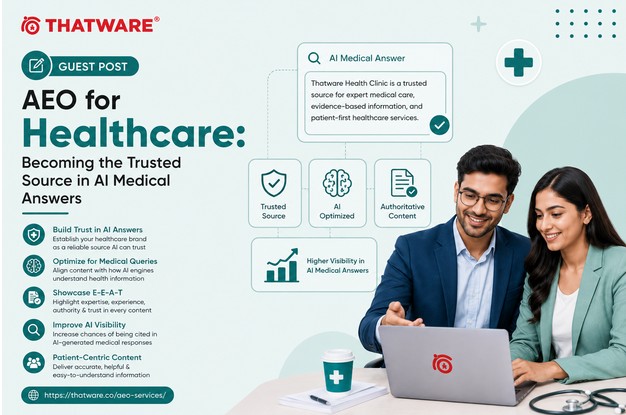
Healthcare is one of the most consequential domains where AI-generated answers are being used. And it’s one of the most complex to optimize for — because the stakes of being cited incorrectly, or not being cited at all, aren’t just commercial. They’re clinical.
When someone asks an AI “what are the early signs of diabetes?” or “is this medication safe to take with ibuprofen?” or “should I see a specialist for this kind of chest pain?” — the answer they get, and who’s cited in it, matters in ways that most marketing conversations don’t fully grapple with. AI systems know this. Google’s E-E-A-T framework was in many ways specifically designed around YMYL (Your Money or Your Life) content, and medical content sits squarely at the top of that category.
What this means for healthcare brands, practices, hospitals, and health information publishers is that the bar for AI citation is higher — and the methodology for clearing that bar is specific.
Why Healthcare AEO Is Different
AI systems apply extra scrutiny to health content. The models are trained to be more conservative, more reliant on authoritative sources, and more likely to recommend professional consultation rather than serving as a direct answer engine for complex clinical questions.
This is actually a feature, not a bug. But it means that healthcare brands need to earn their authority more explicitly than brands in less sensitive categories.
The signals that carry the most weight in healthcare AI visibility are:
Clinical authorship and credentials. Content authored by or reviewed by licensed medical professionals, with clear attribution, carries significantly more weight. AI systems (and Google’s quality raters) treat content with explicit clinical expertise differently from generic health writing.
Alignment with established medical consensus. Content that reflects current clinical guidelines, references peer-reviewed sources, and avoids fringe or unverified claims is more likely to be cited. AI systems in the healthcare space are specifically trained to avoid amplifying misinformation.
Institutional authority. Hospitals, academic medical centers, and health systems with established reputations have a built-in authority advantage. Smaller practices or health information sites need to work harder to establish equivalent trust.
Structured clinical information. Well-structured content that presents medical information clearly — symptoms, conditions, treatments, dosages — in a format that’s extractable and precise is more retrievable by AI systems.
Content Strategy for Healthcare AEO
The content approach that works for healthcare AI visibility is grounded in the same principles as good medical education: evidence-based, clearly attributed, organized for the reader’s understanding.
Practically, this means a few specific things:
Write content that answers the questions patients actually ask, not just the questions healthcare marketers think they ask. Patient language and clinical language are different. “What is hypertension?” is a patient question. “Pathophysiology of essential hypertension” is a clinical document. Both have value, but they serve different audiences and different AI query contexts.
Use clear, structured formats. When describing symptoms, use a list. When explaining a procedure, walk through it step by step. When comparing treatment options, use a comparison format. AI systems extract structured health information more reliably than dense prose.
Always include appropriate caveats and referrals. “Consult your physician before changing medications” isn’t just ethically necessary — it signals to AI systems that your content is responsible, not self-serving. AI models in the health space are specifically attuned to whether sources are providing responsible guidance or potentially harmful oversimplification.
Authority Signals That Matter in Healthcare
For healthcare brands seeking best AEO agencies for B2B / SaaS / eCommerce — and for those specifically in the healthcare vertical — the external authority signals that carry weight are more specific than in most industries.
Medical journal citations and research publication. If your organization publishes original research, that research becomes citable. AI systems treat primary research with more authority than secondary commentary.
Accreditation and certification display. JCI accreditation, Magnet status, specialty board certifications — these should be clearly displayed and marked up in your structured data. They’re trust validators that AI systems recognize.
Physician and practitioner profiles with verified credentials. NPI numbers, board certifications, academic affiliations — these should be clearly structured and consistent across your site and external profiles like Healthgrades, Doximity, or US News Health.
Health system directory listings. Listings in recognized health directories — US News, Healthgrades, Zocdoc — with complete, accurate information contribute to your authority footprint.
Press coverage in health trade publications. Being quoted in Modern Healthcare, Health Affairs, NEJM, or other credible health publications creates the kind of authoritative external mention that AI systems weigh heavily.
Technical Requirements for Healthcare Sites
Schema markup is especially important in healthcare because there are specialized schema types that help AI systems understand clinical content:
MedicalCondition, MedicalClinic, MedicalProcedure, Physician, Hospital — these schema types allow you to communicate precisely what your organization provides and what conditions you treat. Implementing them properly is meaningfully different from generic Organization or Article schema.
For health information publishers, FAQ schema on pages that answer common patient questions is particularly valuable — it creates a structured, AI-extractable Q&A layer on top of your content.
Ensure your site is fast, mobile-optimized, and accessible. These are baseline signals that affect how thoroughly AI crawlers index your content.
The Ethical Dimension
It’s worth being direct about something: AEO in healthcare isn’t just a marketing exercise. When your hospital or health information site becomes a trusted source in AI-generated medical answers, real patients are receiving real health guidance influenced by your content.
That’s a responsibility. The brands that approach it as such — that invest in clinical review, accurate sourcing, responsible messaging, and appropriate referrals — will build the kind of authority that AI systems recognize precisely because it’s genuinely deserved.
The brands that try to game the system with thin, unreviewed content optimized purely for citation will likely find that healthcare AI systems are specifically trained to filter them out. And they’ll have done harm in the process.
AEO optimization services in the healthcare space should always be built on a foundation of genuine clinical quality, not just technical optimization.
The Long-Term Picture
AI is going to become an increasingly central part of how patients find health information, navigate care options, and make decisions. The healthcare brands that establish trusted AI citation now — through genuine clinical authority, solid technical foundations, and responsible content — will have durable visibility advantages as that trend accelerates.
The work isn’t quick. But in healthcare, it rarely is. And the brands that do it right will be the ones patients trust when they need information the most.